Offer available seats
Create a clear shared-ride plan with the departure area, timing and number of available seats.

Getting to a race, training session or outdoor activity is part of the experience—and it can create unnecessary emissions when people make the same journey in separate vehicles.
Lumopa helps active people coordinate shared rides, use available seats more effectively and make practical travel plans around real activities.
Races and outdoor activities bring people to the same place at a similar time. When participants travel separately from nearby areas, the result can be more vehicles, higher individual costs, additional congestion and avoidable emissions.
The exact impact varies by distance, vehicle, occupancy, public transport and local infrastructure. That is why Lumopa focuses first on a practical action: helping people coordinate the journeys they were already planning.
As an event-specific example, HOKA UTMB Mont-Blanc reports that participant travel represents nearly 86% of its own event carbon footprint. This figure is specific to that event and should not be treated as a universal percentage for every race. Read the official UTMB mobility information.
Lumopa does not decide how somebody must travel. It helps people make existing journeys easier to understand and share.
Create a clear shared-ride plan with the departure area, timing and number of available seats.
Let people attending the same activity know that transport is part of your plan.
Agree on meeting points, luggage, timing, reasonable direct costs and the journey home.
Discover relevant activities closer to where you live, train or already plan to travel.
A responsible travel plan depends on the route, timetable, equipment, accessibility needs and the people travelling. There is no single answer for every event.
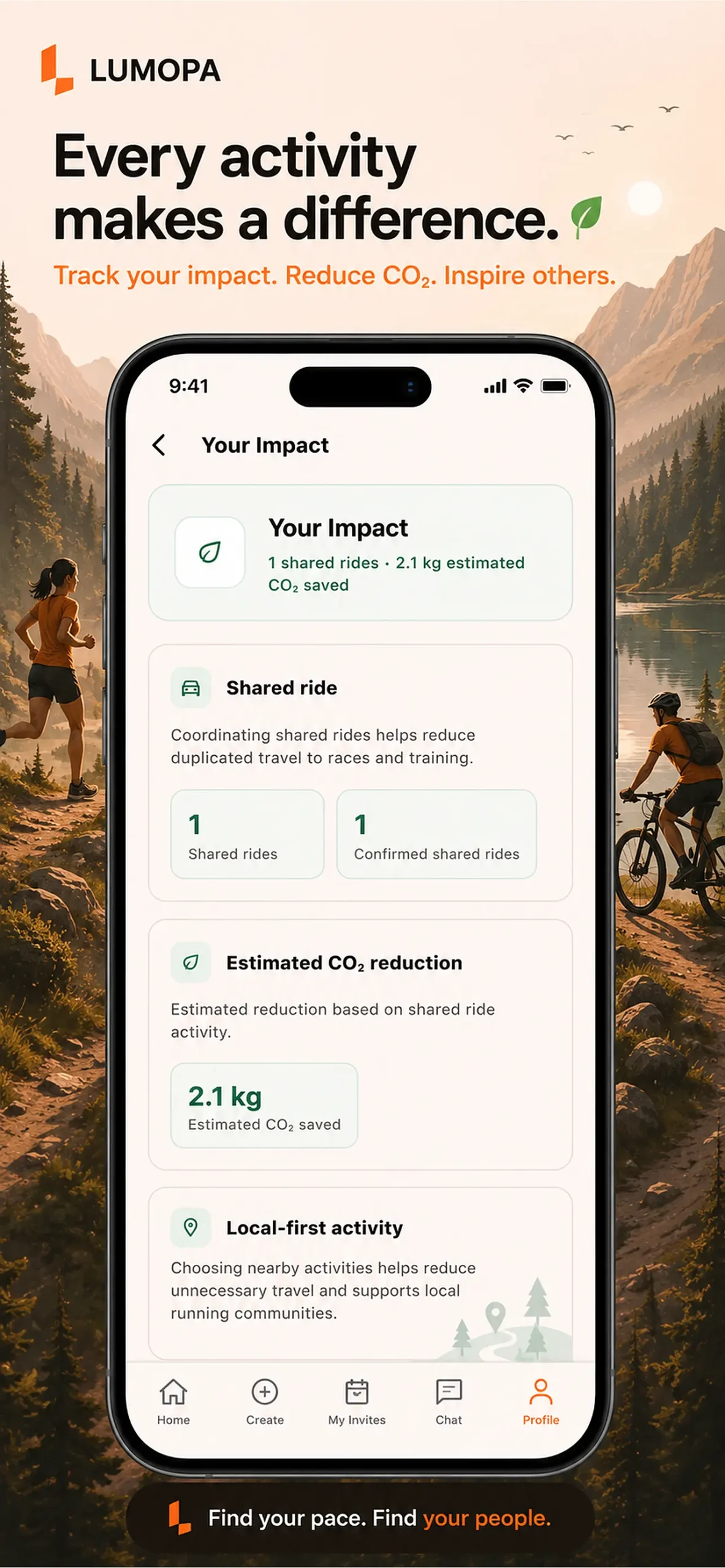
If four people who would otherwise use four separate cars travel in one suitable vehicle, three duplicated vehicle journeys may be avoided. The real emissions difference still depends on distance, vehicle type, fuel, occupancy and whether the shared journey replaces another trip.
Better use of available seats can reduce the number of separate vehicles travelling to the same activity.
Participants can agree how to share reasonable direct journey costs instead of paying for duplicated travel.
Fewer individual arrivals can help reduce parking demand and congestion around a busy event location.
Lumopa impact figures are practical estimates intended to help users understand possible differences between travel plans. They are not certified carbon accounting, verified emissions reporting or a guarantee of actual savings.
Suitable reference sources include the ADEME Base Empreinte and the current UK Government greenhouse gas conversion factors. The selected source, factor year and calculation assumptions should be published alongside any future Lumopa estimate.
Race organizers can use Lumopa as a community coordination layer alongside official transport information.
Lumopa for Race OrganizersLumopa does not replace official registration, transport operations, safety communication or event carbon accounting.
Offer transport, look for transport and coordinate practical journey details around a real activity.
Clear estimates of shared journeys, vehicle occupancy, avoided trips and possible CO₂e differences.
Aggregated community and mobility information that may help organizers understand participant travel.
Shared rides can reduce duplicated vehicle journeys when people travelling to the same activity use available seats in one vehicle instead of driving separately. The actual difference depends on distance, vehicle type, occupancy and the journey that was replaced.
No. Lumopa figures should be treated as estimates unless they are produced through a separately verified carbon-accounting process. Any estimate must state its assumptions, emissions-factor source and limitations.
Not necessarily. Walking, cycling and suitable public transport may have a lower impact. A shared ride can be useful where those options are unavailable, impractical or do not cover the final part of the journey.
No. Lumopa provides coordination tools. Shared rides remain private arrangements between users, who are responsible for confirming the driver, vehicle, insurance, route, timing, costs and safety.
Organizers can direct participants to Lumopa for community-led shared-ride coordination while continuing to publish authoritative shuttle, public transport, parking and access information through official event channels.
Check whether part of the journey can use public transport, whether an official shuttle is available or whether available vehicle seats can be shared. Keep accessibility, equipment, timing and a safe return plan ahead of an environmental estimate.
Use Lumopa to coordinate a clear activity and explore shared travel where it is practical. Availability depends on what people have created for a place or event.